
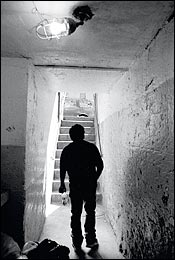
In this case, the court did not address the issue of whether or not this basement apartment was legal and safe to inhabit.
Howard v Grant 2021 NY Slip Op 50938(U) Decided on August 27, 2021 Civil Court Of The City Of New York, Bronx County Black, J.:
"BACKGROUND AND PROCEDURAL HISTORY
Petitioner Patricia Howard ("petitioner") commenced this illegal eviction proceeding seeking to be restored to possession of the premises 3337 Fish Avenue, Basement Apartment, Bronx, New York, and an award of treble damages pursuant to RPAPL § 853. Petitioner alleged that on or about February 12, 2021, respondent landlord Aletha Grant ("respondent" or "respondent landlord") illegally evicted her from the subject premises, where she had resided since March 2020. Respondent did not appear on the original court date, and upon petitioner's submission of appropriate proof of service of the papers commencing this proceeding, the court scheduled inquest and mailed notice of that date to respondent. Following inquest on April 9, 2021 the court entered a judgment in favor of petitioner. This proceeding now comes before the court on respondent Grant's motion for vacatur of the default judgment entered against her pursuant to CPLR § 5015(a)(1).
Respondent submitted a sworn affidavit in support of her Order to Show Cause in which she asserts that she was not served with the relevant court papers sent by petitioner and that she did not receive the postcards sent by the court, to inform her of the pendency of the proceeding and the court date. Respondent further asserted that petitioner abandoned the apartment in early January 2021, that respondent changed the locks at the premises to secure her property, and that in February 2021 the police asked petitioner to leave the premises because petitioner could not provide proof that she resided at the premises. Finally, respondent asserts that she never changed the locks on petitioner's apartment. On the return date of the motion respondent informed the court that she had installed a new tenant at the premises and that he had been residing at the premises for some time.
Petitioner thereafter submitted opposition and a cross-motion to join the occupant as a respondent-party in this proceeding, among other relief. Petitioner seeks to enforce the judgment and order already issued against respondent landlord. In addition, petitioner seeks a judgment of possession against respondent Rivers, and issuance of a warrant of eviction against him. The court granted that branch of petitioner's cross-motion which sought to join Rashawn Rivers as a party. Following conference, an evidentiary hearing on the motion proceeded with all parties represented by counsel. For the reasons stated below, the court denies respondent landlord's motion, declines to vacate the order issued on default and grants the balance of petitioner's cross-motion to the extent stated below.
RESPONDENT-LANDLORD'S EVIDENCE
Respondent Aletha Grant, also known as Aletha Lenora or "Nora" Grant, or Aletha Alberga, testified that she resides at the subject building, 3337 Fish Avenue, Bronx, New York, which she owns. Ms. Grant stated that the deed for the building lists the property as a two-family house, with one unit on the first floor and another unit on the second floor; however, respondent uses the building as a three-unit building, utilizing the basement as a separate rental unit. Respondent herself resides on the first floor and rents out the basement and the second floor.
Respondent testified that she rented the basement unit to petitioner in or about March 2020. Respondent testified that she did not provide petitioner with a written lease at that time, explaining that she does not consider herself a landlord of the de facto multiple dwelling, and that she does not usually provide leases or rent receipts to her tenants. Respondent also testified that she was unaware of the legal requirement to register multiple dwellings with the New York City Department of Housing and Preservation Development.
Respondent testified that she and petitioner entered into a verbal rental agreement for a month-to-month tenancy at $1,100 per month. Petitioner is a senior citizen and respondent had surmised that petitioner's maturity [*2]would make her a more reliable and reasonable tenant. Respondent stated that she made clear to petitioner at the start of the arrangement that she would be requiring access to the basement unit, which contains the electrical and boiler systems for the building. The entrance to the basement area is located at the side of the house in the driveway, through the side door leading down under the first floor. Respondent testified that on at least three occasions she required access to the basement area due to outages caused by electrical system overload, in June 2020, August 2020, and January 2021.
In June 2020, after the lights in the building shorted out, respondent called petitioner to let her know she would require access to the basement. Respondent testified that she also knocked on the basement door, waited approximately an hour, and then knocked again, but receiving no response respondent entered the basement. As respondent entered the premises, she encountered petitioner exiting her bedroom. Respondent testified that petitioner called the police to report respondent's intrusion into the unit. A similar incident occurred in August 2020 when respondent accessed the basement due to another electrical outage reported by the upstairs tenant.
Respondent testified that over time her relationship with petitioner deteriorated. Unlike the tenant on the second floor, petitioner began demanding rent receipts. Then, petitioner began falling behind on paying her rent. Respondent tried to contact petitioner via text message regarding the rent due in June 2020. When petitioner did not respond, respondent commenced a holdover eviction proceeding against petitioner in October 2020, under L & T Index No. 17309/20. That proceeding is still pending and respondent's contact information listing the subject building remained unchanged. Ultimately, petitioner represented to respondent that she would be looking for a new apartment. Respondent alleges that petitioner and petitioner's daughter threatened her, and that she no longer felt safe staying at the premises. Respondent stated that she temporarily relocated to 1232 Wheeler Avenue Bronx, New York to stay with a friend, on an unspecified date. Respondent testified that during the period when she did not regularly occupy her unit at the subject building, she periodically returned to the building, perhaps once or twice each month but she did not regularly check the mail at her home, because she had arranged for all her bills to be paid online, not by mail. She began the process of returning to fully re-occupy her unit at the subject building sometime in March or possibly April 2021.
Respondent testified that she received none of the notices about this case and that she only learned about this proceeding after the court had rendered its decision in favor of petitioner. Respondent initially could not recall how or when she came into possession of the court's order, indicating that it might have been taped to the door of the building or passed to her by one of her tenants in either April or May of 2021.
Respondent stated that in or around the second or third week of January 2021, the second-floor tenant reported that the lights inside her unit had gone out. Respondent went to the building to address the issue. Upon entering the basement, respondent found the basement unit vacant, and the door ajar. Respondent stated that she saw no furniture, clothing, or other personal items inside the apartment. Although she had not communicated with her tenant since approximately August 2020, respondent testified that she assumed petitioner had moved out of the apartment. Respondent testified that she made no attempt to contact petitioner to confirm that she had permanently vacated the unit. Respondent stated that she was "glad to have the basement empty of Ms. Howard." Respondent did not receive any communication from petitioner that the tenant had moved from the subject premises and acknowledged that petitioner never submitted a formal surrender of her tenancy. Respondent then recruited a friend to put a temporary lock on the basement apartment.
Shortly thereafter, on February 3, 2021, respondent leased the basement to respondent Rashawn Rivers, the current occupant of the unit. Departing from her usual procedure of not issuing written leases to her tenants, respondent testified that she and Mr. Rivers executed a written one-year lease for the apartment. Petitioner signed that lease using her married name, Aletha Alberga. Respondent testified that she collected a security deposit and the first month's rent from Mr. Rivers when they signed the lease. Respondent testified that she was present at the subject premises on February 13, 2021, to address a leak reported by one of her tenants. While petitioner specifically recalled [*3]going to the subject building to address a leak on the date, she did not recall whether she saw petitioner or the police at the premises on that day. Respondent also asserted that in February 2021 the police refused to help petitioner and directed petitioner to leave the apartment because petitioner could not produce proof that she resided at the premises. Respondent did not explain how she acquired this information regarding petitioner's interaction with the police in February 2021.
RESPONDENT RIVERS' EVIDENCE
Occupant Rashawn Rivers testified that he currently resides at 3337 Fish Avenue, Basement Apartment, Bronx, New York and submitted a copy of his lease. Rivers Exh. A. Mr. Rivers testified that he had been homeless for some months prior to moving into the subject premises, that he learned about the apartment from family members who live on the same street as the subject building and that the apartment is affordable and conveniently located. Mr. Rivers testified that the apartment was completely empty on February 3, 2021 when he was at the subject premises signing the lease for the unit. Mr. Rivers stated that he had never met petitioner before this court proceeding.
PETITIONER'S EVIDENCE
Petitioner testified that in February 2020 she moved to the subject premises after making an agreement with respondent to pay $1,100 per month for the basement apartment and tendering to respondent $1,100 as a security deposit. She initially tendered rent payments in cash directly to respondent, but around May 2020 she began paying her rent by money orders. Petitioner testified that she had continuously resided at the subject premises and paid for cable service in her apartment. On or about October 1, 2020, petitioner received court papers concerning a landlord-tenant holdover eviction proceeding commenced by Aletha Grant naming petitioner herein as the respondent therein, under index number L & T 17308/20. Petitioner's Exhibit 5. Ms. Howard went to Bronx Housing Court to answer that petition and was informed by the court staff that due to the COVID-19 pandemic the proceeding was stayed until further notice. Petitioner never subsequently received any notice requiring her to return to court, or any other notice regarding any eviction proceeding. This court takes judicial notice of the case summary for index number L & T 17308/20, and notes that no warrant of eviction has been issued in that proceeding.
Petitioner testified that on February 12, 2021, she left her apartment between noon and one o'clock in the afternoon and returned at around six-thirty in the evening. As she approached the subject building petitioner saw a padlock on the gate to the property. Petitioner did not have a key to that lock and could not enter the property. She got the attention of a passing police car and sought the officers' assistance. The officers spoke with a woman in the subject building who was unknown to petitioner and who represented herself to be a visitor. Petitioner was able to gain entrance to the yard of the property but was unable to gain access to her apartment because her key to her front door lock no longer worked to open the door. Petitioner realized that the lock had been changed.
The next day, February 13, 2021, petitioner returned to the subject premises with a police escort and was able to enter her apartment with the assistance of the police officer. Once inside the premises, petitioner observed the woman from the day before, as well as respondent landlord handling a box of petitioner's belongings. When questioned by the officer, respondent denied knowing petitioner, but later informed the police officer that petitioner's belongings were in a storage unit and provided the officer a receipt for the storage unit. The officer accompanied petitioner to the storage unit, where she was able to identify and retrieve some of her belongings.
Coral Hanson, petitioner's friend of ten years, testified in support of petitioner. Ms. Hanson testified that on February 5, 2021, she visited petitioner at the subject premises at approximately six o'clock in the evening, when she stopped by to return money she had borrowed from petitioner. When she arrived at the subject building, Ms. Hanson called petitioner, who came outside and let her into her basement apartment. Ms. Hanson described the location of the apartment in relation to the rest of the building and her recollection of petitioner's furniture inside the unit. She recalled visiting with petitioner for about half an hour on that occasion and that she saw no one else at the subject premises that evening.
APPLICABLE LAW AND ANALYSIS
A party seeking to vacate a default judgment pursuant to CPLR § 5015(a) must demonstrate both a reasonable excuse for the default, and a meritorious defense to the underlying proceeding. Leader v Parkside Group, 174 AD3d 420 (1st Dept 2019). "The preference for deciding cases on the merits does not justify vacating a default judgment where the moving party fails to satisfy the two-prong test of showing a reasonable excuse for the default and a meritorious defense." Id. at 421. The reasonableness of the excuse is a determination within the sound discretion of the court. GMAC Mtge. LLC v Guccione, 127 AD3d 1136 (2nd Dept 2015), citing, Walker v Mohammed, 90 AD3d 1034 (2nd Dept 2011); Luisa v Zakir, 72 Misc 3d 138(A) (App Term, 2nd Dept 2021).
Respondent Grant asserts that she received neither the papers commencing this illegal eviction proceeding, nor the court's mailed notification of the date set for inquest. The proceeding was initially calendared for March 31, 2021, on which date respondent failed to appear. Petitioner submitted proof of timely service upon respondent at the subject building by certified mail, return receipt requested, and by regular mail with certificate of mailing, as required by the terms of the order to show cause. Upon proof of proper service, the proceeding was adjourned for inquest to April 9, 2021, and postcards were mailed by the court clerk to the subject address to inform respondent of the court date. When respondent defaulted for the second time, the court held inquest and based upon the credible evidence, the court awarded a judgment to petitioner.
Respondent's testimony at the hearing was often vague, evasive and/or contradictory. Respondent testified that she did not receive notice of this illegal eviction proceeding prior to the issuance of the default judgment against her, stating that she had been absent from the premises during the relevant period and that during that period and perhaps thereafter she did not regularly check her mail. However, respondent also testified that she began moving back to her residence at the subject building sometime during March 2020, around the time that petitioner commenced this proceeding. As the landlord of the subject building respondent would have been obliged to remain apprised of any pertinent information or notice related to her landlord-tenant relationships, and respondent did not indicate any issues with her mail delivery or access other than her own self-imposed absence for unspecified periods. It remains unclear how respondent came into possession of the court's default order against her. Although respondent could not recall seeing petitioner or police officers at the premises on February 13, 2021, respondent recounted that the police refused to assist petitioner at the subject premises in February 2021.
Based upon the lack of logic of her testimony and respondent's general demeanor during the hearing the court finds respondent not credible, and that respondent failed to demonstrate a reasonable excuse for her default in this proceeding. See Thattil v Mondesir, 275 AD2d 408 (2d Dept 2000) (defendant's conclusory allegations that he did not receive the summons and complaint did not constitute a reasonable excuse for his default); see also Brosnan v Behette, 186 AD2d 165 (2d Dept 1992), and Luisa v Zakir, supra.
As respondent did not show a reasonable excuse for her default, the court need not reach the issue of whether petitioner presents a meritorious defense to the proceeding. However, the court notes that even had respondent been able to demonstrate a reasonable excuse for her default, respondent does not present a meritorious defense. Specifically, respondent asserts that petitioner abandoned the subject premises. To prevail in this defense, respondent must establish that two facts exist concurrently: (1) an intention to abandon or relinquish, and (2) some overt act or some failure to act which carries the implication that the tenant or occupant neither claims nor retains any interest in the subject matter of the abandonment. The burden of proving an abandonment or surrender is on the party seeking to establish it or relying upon such abandonment or surrender. Sam & Mary Housing Corp. v. Jo/Sal Market Corp., 100 AD2d 901 (2nd Dept. 1984); Hui Zhen Wei v 259 East Broadway Associates LLC, 57 Misc 3d 136(A) (App Term, 1st Dept 2017); Ahmed v. Chelsea Highline Hotel, 49 Misc 3d 139(A) (App Term, 1st Dept. 2015); Hip Hop Fries Inc. v. Gibbins Realty Corp., 13 Misc 3d 128(A) (App Term, 1st Dept. 2006); Johnson v. Manning, NYLJ, November 16, 1988, at 21, col.2, (App Term, 1st Dept). Where the tenant or legal occupant claims that she is moving out of the apartment but fails to return the keys to the premises and fails to provide a signed surrender [*4]statement or agreement "the prudent course of action is for the landlord to commence summary dispossess proceedings." See Scherer, Residential Landlord-Tenant Law In New York, § 2:129, 2019-2020 Edition.
Here, respondent presented no proof to substantiate her presumption that petitioner abandoned the subject premises and there is currently pending the holdover proceeding commenced by respondent against petitioner, which proceeding has been stayed as a result of the eviction moratorium caused by the COVID-19 pandemic. Respondent acknowledges the absence of a formal surrender or any other communication between the parties to confirm that petitioner relinquished possession of the subject premises. The only indicia of abandonment offered by respondent consists solely of her testimony that she found the subject premises vacant and empty in late January 2021, which testimony the court does not credit. By respondent's own admission, she made no effort to contact petitioner and within days thereafter she entered into a lease agreement with a new tenant.
While the third-party respondent, occupant Rashawn Rivers, corroborates respondent-landlord's account that the apartment was vacant and devoid of any personal possessions on February 3, 2021, almost ten days before the lockout alleged by petitioner took place, the court is skeptical of his timeline. The court also notes that respondent Grant's order to show cause to vacate the default order against her, including the attorney affirmation and petitioner's annexed affidavit, while quite detailed, makes no mention at all of Mr. Rivers or any alleged intervening tenancy at the subject premises. It seems unlikely that a landlord who has already installed a new tenant at the premises would entirely omit that fact from their motion papers where the clear goal was to prevent petitioner's restoration to the premises.
While the court may be sympathetic to the current occupant's predicament, at the time that respondent allegedly rented the subject premises to Mr. Rivers, petitioner remained the tenant of the unit. In weighing petitioner's and respondent-occupant's claims to possession, petitioner clearly presents a superior claim. See S.W.S. Realty Co. v. Geandomenico, 126 Misc 2d 769, 773 (Civ Ct, New York County, 1984) (finding that the equity of restoring to possession an illegally-evicted long-term tenant outweighed the rights of an intervening occupant based on the principle qui prior est tempore, potior est jure, "between equal equities, his whose equity is first in time is strongest in right. Thus, in a contest between equities or interests in property, the rule to be applied primarily is that, other things being equal, the interest which is shown to have been earlier in time is entitled to prevail over the other" citing 20 NY Jur, Equity § 120). Additionally, the court notes that the intervening occupant was at the premises for a brief period and became aware of the challenge to his occupancy soon thereafter. See Pomeroy Co v Thompson, 5 Misc 3d 51 (App Term, 1st Dept 2004).
Here, petitioner presents a superior claim to possession both at law and in equity. Where, as here, respondent-landlord did not properly evict petitioner, petitioner's leasehold continued despite the wrongful dispossession, and thus respondent landlord had no leasehold to convey to Mr. Rivers. As petitioner held the leasehold to the subject premises and respondent landlord had no leasehold to convey to Mr. Rivers, the court should not even have to balance the equities, as long as petitioner moved promptly to be restored to the subject premises, which she did. If the court must balance the equities, however, that balancing clearly favors petitioner. Ms. Howard is a 71-year-old woman who has been a tenant at the subject premises for a year prior to being ousted from possession by respondent Grant. Mr. Rivers assumed occupancy of the premises only recently and was made aware of the possible impact of this proceeding to his continued occupancy shortly after his purported tenancy commenced. The court is sympathetic to the difficulty Mr. Rivers has encountered and may again encounter in finding suitable housing and makes its determination without prejudice to any claim for damages Mr. Rivers may present against respondent Grant.
CONCLUSION
Based on the foregoing, respondent's motion to vacate the default judgment entered on April 9, 2021 is denied and respondent is directed to restore petitioner to possession forthwith. Petitioner's cross-motion for a judgment of possession against respondent occupant Rivers is granted and the warrant may issue forthwith against both respondents. However, in the interest of justice, execution of the warrant as against respondent Rivers is stayed [*5]10 days from the date of this order.
This constitutes the decision and order of the court."





 Posts
Posts


