Showing posts with label Right of Publicity. Show all posts

Wednesday, March 24, 2021

THE STANDARD MODEL RELEASE IN ISSUE


A standard model release, with respect to stock images, etc., may provide: "For  valuable  consideration,  I  hereby  irrevocably  consent  to  and  authorize  the  use  and reproduction by you, or anyone authorized by you, of any and all photographs which you have this day taken of me, negative or positive, proofs of which are hereto attached, for any purpose whatsoever, without further compensation to me.  All negatives, together with the prints shall constitute your property, solely and completely. 

Does "for any purpose whatsoever" mean "for any purpose"? Does "anyone authorized by you" mean "anyone"? Some well known models signed standard model/image releases to a third-party. Several New York strip clubs purchased the rights to use the photographs from the third-party for their strip clubs ads. The models brought an action against the strip clubs for misusing their images claiming that their images utilized for the adult entertainment industry damages their careers.

ELECTRA v. 59 MURRAY ENTERPRS., INC., Court of Appeals, 2nd Circuit February 9, 2021 (in part):

"Relying on the release agreements in the record, the district court concluded that Appellants had executed agreements releasing all their proprietary rights to the photographs and authorizing releasees to allow third parties to use the photographs for any purpose. The district court held that the release agreements disclaimed Appellants' rights to challenge the use of the photographs, barring Appellants' Section 51 claims. In a footnote, the district court suggested that though it did not need to address the question of whether the releases constituted "written consent" for purposes of Section 51, it was "inconsistent" with the statute "for plaintiffs that have signed unlimited releases to rely on the absence of written consent in pursuing damages under that statute." Toth, 2019 WL 95564 at *11 n.14.

Appellants contend that this was an error of law, arguing that Appellees lacked written consent from Appellants, the releasees, or anyone else to use the images; that Appellees were not third-party beneficiaries of the release agreements; and that the release agreements did not constitute written consent for purposes of Section 51. We agree.

Under New York law, "the terms of a contract may be enforced only by contracting parties or intended third-party beneficiaries of the contract . . . ." Rajamin v. Deutsche Bank Nat. Tr. Co., 757 F.3d 79, 86 (2d Cir. 2014). Here, both parties agree that the Club Companies and their contractors—including Brown, IMC, and Melange—were not parties to the releases, and that there are no other agreements between Appellants and the Club Companies or their contractors authorizing the use of the photographs. In addition, Appellees conceded during oral argument that the contractors secured no legal rights to use the photographs, such as through an assignment or license. Appellees and their contractors are plainly not third-party beneficiaries of the release agreements. See State of Cal. Pub. Emps.' Ret. Sys. v. Shearman & Sterling, 95 N.Y.2d 427, 434 (2000) (explaining that a "party asserting rights as a third-party beneficiary must establish," inter alia, "that the contract was intended for his benefit"). Appellees therefore had no legal rights under the releases or any subsequent agreement to use the images and cannot rely on the releases to bar Appellants' claims.

We further conclude that the releases are not written consent for purposes of Section 51. The text of the statute requires a party to have "written consent" to use the image, though it allows "sale or transfer" of the image "for use in a manner lawful under" Section 51. N.Y. Civ. Rights Law § 51. As case law demonstrates, written consent in favor of one party does not allow others to use an image for trade or advertising. See, e.g., Chambers v. Time Warner, No. 00-cv-2839, 2003 WL 749422, at *4 (S.D.N.Y. Mar. 5, 2003). This is true no matter how broadly an agreement releases proprietary rights to the releasee. In Rosemont Enterprises, Inc. v. Urban Systems, Inc., for example, the New York Supreme Court held—in an action under Section 51 brought by Howard Hughes against the maker of "The Howard Hughes Game"— that Hughes's "exclusive assignment of the right to exploit the Hughes name and personality" to another party did not defeat the claim. 340 N.Y.S.2d 144, 144, 147 (Sup. Ct. 1973), aff'd as modified, 345 N.Y.S.2d 17 (App. Div. 1st Dep't 1973). The court explained that Hughes was "free to protect himself from the exploitation of his name and likeness against all the world except [the assignee]. It is only between them will that assignment constitute a defense to a similar law suit." Id. at 147.

A cause of action under Section 51 does not depend on the proprietary rights a plaintiff has in a particular image. In Gautier v. Pro-Football, Inc., the Appellate Division explained that Section 51 provides "primarily a recovery for injury to the person, not to his property or business." 106 N.Y.S.2d 553, 560 (App. Div. 1st Dep't 1951), aff'd, 304 N.Y. 354. Gautier continued,

True, where an individual's right of privacy has been invaded there are certain other elements which may be taken into consideration in assessing the damages. Thus, where a cause of action under the Civil Rights statute has been established, damages may include recovery for a so-called `property' interest inherent and inextricably interwoven in the individual's personality, but it is the injury to the person not to the property which establishes the cause of action. That is the focal point of the statute.

Id. (citation omitted).[6] The district court's conclusion that the release agreements defeated Appellants' claims would construe Section 51 claims as coextensive with claims for breach of contract: only the releasees, who retained proprietary interest in the image, could sue. But this is wrong, even in this "modern era" of the internet. Cf. Gautier, 304 N.Y. at 360. "Section 51 of the Civil Rights Law was not enacted . . . to supplement causes of action based on contracts . . . ." Gautier, 106 N.Y.S.2d at 560-61.

Thus, Lee's and Mayes' releases in favor of Dreamgirl, Koren's release in favor of Gianatsis Design Associates, and Golden's release in favor of Leg Avenue do not constitute written consent for all others to use their images for purposes of advertising or trade. That their releases conveyed their proprietary rights to the photographs does not defeat their claims, because their cause of action under Section 51 is based on their statutory rights, not their proprietary rights in the photographs. And while the releases could provide a defense in an action against the releasees or those who could assert lawful use by reason of assignment or license, Appellees concede that they had no legal rights to the images. Appellants therefore have established that Appellees used their images without written consent, and they are entitled to summary judgment as to Appellees' liability under Section 51."

In the following article, NYLJ March 24, 2021, Release Did Not Grant Consent To Use Likeness Under Civil Rights Law, Tal S. Benschar, the author suggests:

"A release of an image intended for exploitation in commercial pro-motion must do more than license proprietary rights. Rather, it should specifically state that the model consents to the use of her image for the purposes of advertisement or trade by any party licensing the photograph. It should also recite that the model has received compensation for this right, and that the agreement is for the benefit of not only the photographer, but also any third party to whom the image is licensed. Of course, in some  cases,  this  might  require  additional compensation to the model, either on a flat-fee basis or a per-use basis. 

Businesses  involved  in  use  of  images  of  models  and  other  individuals should thus beware that they have rights that may be asserted, and that those rights are distinct from the photographers’ rights. Ensuring that both are covered before the advertisement is used can go a long way to insulating the business from expensive litigation."

Tuesday, December 1, 2020

NEW DESCENDIBLE RIGHT OF PUBLICITY IN NEW YORK AND MORE


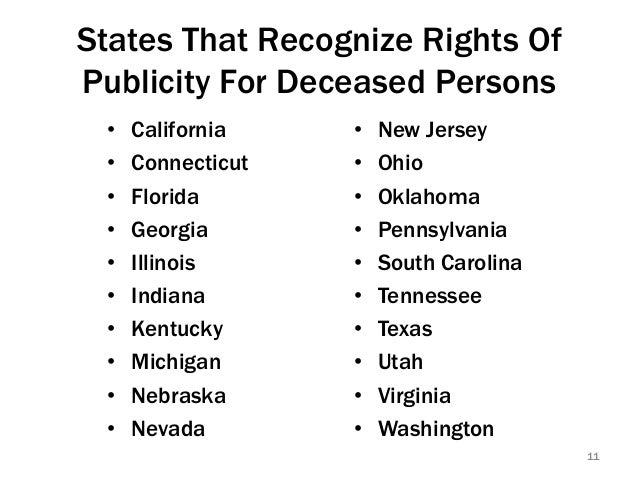
Signed into law yesterday (S5959D /A.5605-C). Only about a dozen states recognize that the right of publicity survives death and in the past, I had utilized the California law to protect the use of images of deceased celebrities when distributors were utilizing their images in the sale of public domain materials.

The new law also prohibits the use of "deepfake" pornography.

"SUMMARY OF PROVISIONS:

Section 1 adds a new Civil Rights Law § 50-f, creating the right of
publicity.

Section 2 adds a new Civil Rights Law § 52-c, creating a private right
of action for unlawful dissemination or publication of a sexually
explicit depiction of an individual.

Section 3 provides the effective date.

 
JUSTIFICATION:

The term "Right of Publicity" originated in the United States Court of
Appeals for the Second Circuit in 1953 in Haelan Laboratories v.  Topps
Chewing Gum to describe the right of individuals to control the use of
their name and likenesses for commercial and other valuable purposes.
Since then, more than half of the states have granted rights of public-
ity to individuals either through the common law or by statute.

The Right of Publicity refers to every individual's inherent right to
control the commercial use of his or her personal characteristics, which
can include name, portrait or picture, voice or signature, each a part
of an individual's persona. The Right of Publicity also protects a
deceased performer's digital replica in expressive works to protect
against persons or corporations from misappropriating a professional
performance.

The most critical function of the Right of Publicity is control. The
Right of Publicity, even though it is a property right, is not merely a
property asset, like a painting or real estate, for estate tax purposes.
The Right of Publicity ensures that if a person, or that person's
successor in interest, does not seek to commercialize the right, they
are not compelled to do so.

This bill provides for a post mortem right of publicity for forty years
after the death of an individual, allowing successors in interest to
provide notice of such interest through a public registration and post-
ing maintained by the New York Secretary of State. Along with providing
for a post mortem right of publicity, the bill also has exclusions
consistent with constitutionally protected freedom of speech.

Finally, the Right of Publicity created through this legislation applies
to acts that occur within New York State.  In conclusion, this bill is
balanced in protecting essential first amendment rights consistent with
current law while maintaining the current status of the right of privacy
law and still providing protections for an individual's right of public-
ity, whether they are a child or an adult, for forty years after death.
This bill also establishes protections for victims of nonconsensual
digitally manipulated sexually explicit material, such as deepfake
pornography.

 
LEGISLATIVE HISTORY:

Similar to S5857 of 2017 - died on calendar, and S5857B of 2018 -
referred to judiciary with no further action

 
EFFECTIVE DATE:
This act shall take effect on the one hundred eightieth day after it
shall have become a law, and shall apply to all living individuals and
deceased individuals who died on or after such date."

Thursday, June 29, 2017

NEW YORK V. CALIFORNIA (AND OTHER STATES) - DECEASED RIGHT OF PUBLICITY (CONTINUED PART 3)

Talent versus "the suits" is quite common in the entertainment industry. So while SAG-AFTRA, representing the talent, is quite vocal in its support, "the suits" may have another view.

The NYC Bar reports on it's website:

"The Communications and Media Law Committee (Charles S. Sims, Chair) and Art Law Committee (Steven R. Schindler, Chair) issued a report opposing legislation which would provide for a post mortem “right of publicity” for 40 years after the death of an individual, allowing successors in interest to provide notice of such interest through a public registration and posting maintained by the New York Secretary of State. A “right of publicity” describes the “right” of individuals to control the use of their name and likenesses for commercial and other valuable purposes. A similar bill was opposed by the City Bar in 2010 and the Committees believe the present bill raises even further concerns, for both procedural and substantive reasons.  New York Civil Rights Law §§ 50 and 51 (which the bill seeks to amend) have always been strictly construed in New York, favoring the right to freely publish images of persons based on First Amendment principles and only restricting the publication in clear cases where the use of the personality’s image or likeness is for purposes of advertising or trade. The Committees believe that any amendments to this law should be made only for the most compelling reasons, which are not present in the pending legislation."

The full report can be viewed here: http://s3.amazonaws.com/documents.nycbar.org/files/2017170-RightToPublicity.pdf


Wednesday, June 28, 2017

NEW YORK V. CALIFORNIA (AND OTHER STATES) - DECEASED RIGHT OF PUBLICITY (CONTINUED PART 2)


SAG-AFTRA position on the Right of Publicity Bill:

'Pending New York Post-Mortem Right of Publicity Legislation

SAG-AFTRA strongly supports S 5857-A (Savino) / A 8155-A (Morelle), which will revive the New York post-mortem right of publicity under Civil Rights Law sections 50, 51.

SAG-AFTRA represents 30,000+ New York actors, singers, dancers, stunt performers and recording artists who derive part or all of their income from professional performance services, merchandise royalties, and product endorsement. It is for this reason, the United States Supreme Court and other state statutes have long recognized that a performer’s name, image, and likeness is an intellectual property right. These laws recognize the valuable contribution performers make to our nation’s cultural exchange, creative economy, and consumer experience. In sum, S 5857-A / A 8155-A protects the very careers, livelihoods, pensions, and healthcare coverage of SAG-AFTRA’s membership, and encourages professional performers, in both film and music, to invest in the development of their talents, goodwill and legacy.

As you've seen in recent movies and video games, content creators can now create new photo-realistic performances of even deceased performers. Without the right of publicity, a state-based intellectual property right recognized throughout the country, performers and their heirs have no law on the books to protect them.

Mythbusters

The Right of Publicity is Unconstitutional – FALSE

The United States Supreme Court and appellate courts across the country have clearly stated that a state can protect its performers without running afoul the Constitution. Other creators, including writers and journalists, are fully protected by the broad rights of the First Amendment to comment on, report on, or poke fun at public and private figures. In fact, A 8155-A (Morelle) / S 5857-A (Savino) gives creators even more statutory protections beyond what is required by the First Amendment.

23 other states, including California, already have a post-mortem right of publicity. New York state, the media capital of the world, lags behind.

A 8587-A / A 8155-A is Attempting to Prevent Unauthorized Biographical Films - FALSE

SAG-AFTRA fully supports the creation of unauthorized audiovisual works about real people and newsworthy events; works that employ many of our members and add to our film history. Another reason why we are supporting the inclusion of statutory exemptions, which again, go beyond what is required of the Constitution.

SAG-AFTRA believes the Supreme Court got it right when it said the right of publicity is more about protecting the economic value of an entertainer’s career than hurt feelings and reputation. This legislation seeks to clarify that the digital insertion of living or deceased performers into audiovisual works (video game, movie, TV show) to play a fictional character without permission is still arguably a violation of individuals’ right of publicity. In other words, in the event of this kind of theft, a judge, in a court of law, would be able to make a factual and legal determination. Content creators would still have the broad protections of the First Amendment and copyright preemption case law at their disposal. The clarification we advocated for is in response to ever-evolving new technologies, so that performers can have their day in court when their image is stolen in this way."

Tuesday, June 27, 2017

NEW YORK V. CALIFORNIA (AND OTHER STATES) - DECEASED RIGHT OF PUBLICITY (CONTINUED PART 1)


S.6857-A / A.8155-A was proposed this year to amend the civil rights law, in relation to the right of publicity and to amend the civil practice law and rules, in relation to the timeliness of commencement of an action for violation of the right of publicity.

According to the bill's sponsors:

"The term "Right of Publicity" originated in the United States Court of Appeals for the Second Circuit in 1953 in Haelan Laboratories v. Topps Chewing Gum to describe the right of individuals to control the use of their name and likenesses for commercial and other valuable purposes. Since then, more than half of the states have granted rights of publicity to individuals through either the common law or by statute.

The Right of Publicity refers to every individual's inherent right to control the commercial use of his or her personal characteristics, which can include name, voice, signature, photograph, image, likeness, distinctive appearance, gestures, or mannerisms. The most critical function of the Right of Publicity is control. The Right of Publicity, even though it is a property right, is not merely a property asset, like a painting or real estate, for estate tax purposes. The Right of Publicity ensures that if a person, or that person's successor in interest, does not seek to commercialize the right, they are not compelled to do so.

This bill provides for a post mortem right of publicity for forty years after the death of an individual, allowing successors in interest to provide notice of such interest through a public registration and posting maintained by the New York Secretary of State. Along with providing for a post mortem right of publicity the bill also has exclusions consistent with constitutionally protected freedom of speech.

Finally, the Right of Publicity created through this legislation applies to acts that occur within New York State regardless of the deceased individual's domicile, residence, or citizenship. This way we are able to prevent anomalous results in the application of the law to individuals who do not have a Right of Publicity in their domicile or country.

In conclusion, this bill is balanced in protecting essential first amendment rights consistent with current law while still providing protections for an individual's right of publicity during life and for forty years after death."

Monday, June 26, 2017

NEW YORK V. CALIFORNIA (AND OTHER STATES) - DECEASED RIGHT OF PUBLICITY


Under Cal. Civ. Code § 3344.1, post-mortem publicity rights are available for seventy (70) years after death. The statue provides a cause of action for the unauthorized use of a “deceased personality’s” “name, voice, signature, photograph, or likeness” on products or merchandise, or for the purposes of advertising or promotion of such items.


This statute was enacted in part in response to Lugosi v. Universal Pictures, 603 P.2d 425 (Cal. 1979. The heirs of Béla Lugosi sued Universal Studios in 1966 for using his personality rights without the heirs' permission. The trial court ruled in favor of the Lugosi heirs, but Universal Studios won the case in an appeal. The court determined that a dead person had no right to his likeness, and any rights that existed did not pass to his heirs.