Showing posts with label Transfers of Property. Show all posts

Wednesday, April 17, 2019

A PRESUMPTION OF COMPETENCE WHEN DAD REMARRIES


This is a familiar fact pattern. A parent transfers family home to joint ownership with new wife. At death of parent, the children claim undue influence. Perhaps, the answer is for the parent to just transfer a life estate to the new wife, unless the intention is not to leave the property to the children.

Mastrantoni v Mancini, 2019 NY Slip Op 02698, Decided on April 10, 2019, Appellate Division, Second Department:

"The plaintiff commenced this action against the defendant, her father's widow, inter alia, for a judgment declaring that a deed dated July 21, 2009, is null and void. Pursuant to that deed, the plaintiff's father, Armando Mancini (hereinafter the decedent), transferred ownership of residential property, where he resided with the defendant for many years, from himself alone to himself and the defendant. The decedent died on October 19, 2014. According to the plaintiff, when the decedent executed the deed, he was incompetent to do so and the conveyance was the product of undue influence.

The defendant moved for summary judgment declaring that the subject deed is valid and in full force and effect. The Supreme Court granted the motion and issued a judgment in favor of the defendant and against the plaintiff declaring, inter alia, that the deed is valid and in full force and effect. The plaintiff appeals.

We agree with the Supreme Court's determination to grant the defendant's motion and to declare, inter alia, that the deed was valid and in full force and effect.

"As a general rule, a party's competence is presumed, and in order to set aside a transfer of property on the ground of lack of capacity, it must be established that the party did not understand the nature of the transaction at the time of the conveyance as a result of his or her mental disability" (Buckley v Ritchie Knop, Inc., 40 AD3d 794, 795; see Preshaz v Przyziazniuk, 51 AD3d [*2]752, 753). Here, the defendant established, prima facie, her entitlement to judgment as a matter of law based upon the presumption of the decedent's competence and by submitting, among other things, the deposition testimony of the attorney who prepared the deed and witnessed its execution with a certificate of acknowledgment, establishing that the deed was properly executed (see CPLR 4538; Valenzano v Valenzano, 98 AD3d 661, 661-662; Preshaz v Przyziazniuk, 51 AD3d at 753). In opposition, the plaintiff failed to raise a triable issue of fact as to the decedent's mental capacity on the day he executed the deed (see Crawn v Sayah, 31 AD3d 367, 368).

Similarly, the defendant established, prima facie, that the decedent's conveyance of the subject property by the deed was not the product of undue influence (see Crawford v Smith, 130 AD3d 968, 969; Harris v Pitts, 109 AD3d 790, 791). In opposition, the plaintiff failed to raise a triable issue of fact (see Alvarez v Prospect Hosp., 68 NY2d 320, 324; Bazigos v Krukar, 140 AD3d 811, 814)."

Friday, July 15, 2016

WHEN A VEHICLE OWNER DIES


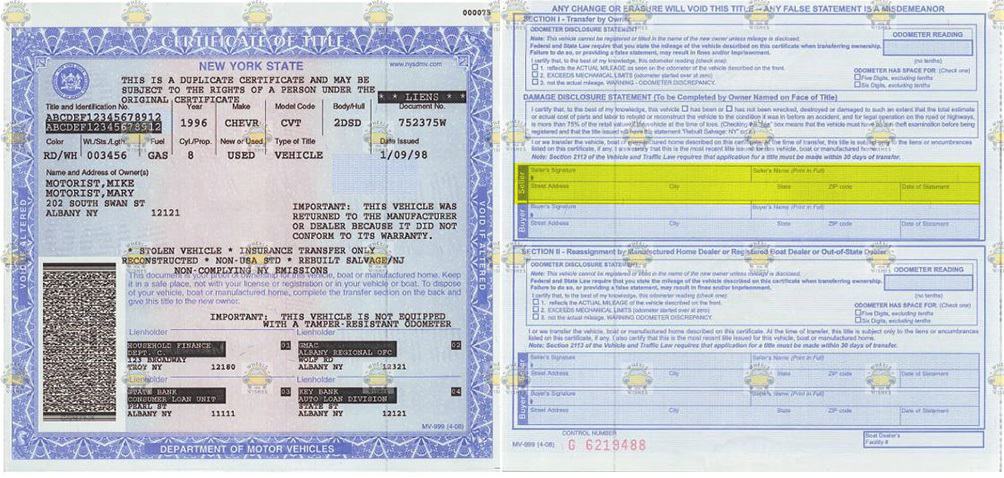
New York is a title state and it is generally assumed that to transfer title of a car belonging to the deceased, letters testamentary or administration are required - a probate of the estate.

But that is not true with respect to all transfers of a deceased vehicle owner. The following is from the New York State Department of Motor Vehicles website and applies to vehicles having a value of $25,000 or less:

" For transfers made by the surviving spouse 'According to the Estates, Powers & Trust Law of New York State,' the owner of one vehicle that has a value of $25,000 or less automatically transfers to the surviving spouse. If the surviving spouse wishes to transfer ownership, they must print the decedent’s name in the “Seller’s Name (Print in Full)” section on the back of the Title and sign their name in the “Seller’s Signature” Section followed by the words “as surviving Spouse”.

The ownership of one vehicle that has a value of $25,000 or less transfers to the surviving children under the age of 21 if there is no surviving spouse or the spouse is disqualified. The spouse or the legal guardian of one of the children must sign the title certificate. When the spouse or the guardian signs the title certificate, they must indicate the relationship to the deceased owner. A spouse writes the word "spouse" under the signature. A guardian writes "guardian of", and the name and the relationship of the child to the deceased owner (for example, "Charles Edwards, guardian of John Smith, son").

To transfer ownership of the vehicle to another person, the spouse or guardian must complete an Affidavit for Transfer of Motor Vehicle (MV 349.1). The form must be notarized. The spouse or guardian also gives the new owner a photocopy of the death certificate or certification of death. The DMV accepts a photocopy of the death certificate or certification of death. When the new owner applies for a vehicle registration or a title certificate, they must provide form MV-349.1 and the copy of the death certificate or certification of death."

For more information, see https://dmv.ny.gov/registration/transfer-ownership-and-acceptable-proofs-ownership#Deceased


Friday, November 13, 2015

BUYING A "TAINTED" HOUSE


This came up in an email discussion - and reminded me of the movie Poltergeist. What is the Seller's duty to disclose the fact that, for example, there was a murder in the home, a contagious disease....or that the house is build on a burial ground and ghosts appear?

In 1995, New York State passed Section 443-a of the Real Property Law which makes the failure to disclose disease-type and crime/death-type impacts not a material defect.  Disease-type impacts protected under the statute are the AIDS or HIV status of a prior occupant, or any other disease not transmitted through occupancy of a dwelling. The crime/death-type impacts under the statute are "a homicide, suicide, or other death by accidental or natural causes, or any crime punishable by a felony."' It also prohibits causes of action against owners, occupants, and their agents for failing to disclose psychological impacts. Real estate agents and brokers are also immune from disciplinary action.

However, there is a procedure for buyers to make a written inquiry if psychological impacts are important to their decision to buy. The buyer or buyer's agent must provide the written inquiry to the seller or the seller's agent. The seller may choose whether or not to respond. If the seller chooses to respond, the seller or seller's agent must provide the response to the buyer or the buyer's agent.

So when representing a buyer - make the inquiry pursuant to RPL Section 443-a. But I don't think it covers ghosts...here it is in its entirety:

"1. Notwithstanding any other provision of law, it is not a material defect or fact relating to property offered for sale or lease, including residential property regardless of the number of units contained therein, that: (a) an owner or occupant of the property is, or was at any time suspected to be, infected with human immunodeficiency virus or diagnosed with acquired immune deficiency syndrome or any other disease which has been determined by medical evidence to be highly unlikely to be transmitted through occupancy of a dwelling place; or (b) the property is, or is suspected to have been, the site of a homicide, suicide or other death by accidental or natural causes, or any crime punishable as a felony. 2. (a) No cause of action shall arise against an owner or occupant of real property, or the agent of such owner or occupant, or the agent of a seller or buyer of real property, for failure to disclose in any real estate transaction a fact or suspicion contained in subdivision one of this section. (b) Failure to disclose a fact contained in subdivision one of this section to a transferee shall not be grounds for a disciplinary action against a real estate agent or broker licensed pursuant to this article. (c) As used in this section, the terms "agent", "buyer" and "seller" shall have the same meanings as such terms are defined in section four hundred forty-three of this article. 3. Notwithstanding the fact that this information is not a material defect or fact, if such information is important to the decision of the buyer to purchase or lease the property, the buyer may, when negotiating or making a bona fide offer, submit a written inquiry for such information. The buyer or the agent of the buyer shall provide the written request to the seller's agent or to the seller if there is no seller's agent. The seller may choose whether or not to respond to the inquiry. The seller's agent, with the consent of the seller and subject to applicable laws regarding privacy, shall report any response and information to the buyer's agent or to the buyer if there is no buyer's agent. If there is no seller's agent, the seller shall inform the buyer's agent, or the buyer if there is no buyer's agent, whether or not the seller chooses to provide a response. 4. This section shall preempt any local law inconsistent with the provisions of this section."

Friday, October 23, 2009

IS IT A LOAN, A GIFT OR WHAT?

When two parties are not related, there is a longstanding principle that the presumption arising from the delivery of a check is that it was tendered in payment of a debt and not as a loan. (Leask v. Hoaoland, 205 NY 171 [1912]; Tn Re Effross, 43 ÄDS39 [1st Dept 1973]), In the absence of other evidence, a loan is not presumed from the making of a check, there must be evidence that the payment was intended as a loan. (Marks v. Kellogg, 170 AD 468 [1st Dept 1915]). Care must be given in considering evidence to overcome the presumption that the check tendered represented some debt or obligation owed. (Kofihler v. Adler., 78 NY 287 [1879]. So what happens when two parties enter into an oral arrangement for a business and one transfers a check to the other party as some sort of contribution to the business? The deal sours and the only written evidence available is a cancelled check? Was the delivery of a check a loan, payment of a debt, or a contribution of a business interest? Was it a gift? That was a matter recently discussed with me and it emphasizes the old saying that an oral agreement is not worth the paper it is written on. Before you enter into any transaction, with family, friends, or business acquaintances.....consult with an attorney.