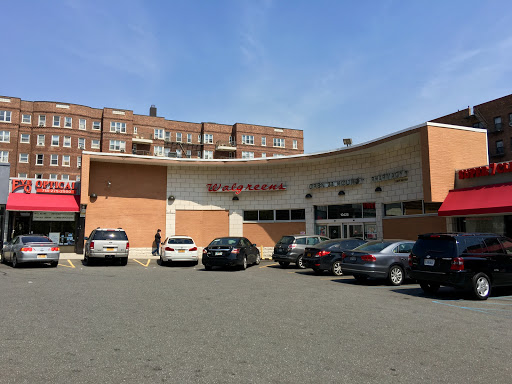
Commercial leases will have new clauses now. As the majority in this case noted: In the wake of First Natl. Stores v Yellowstone Shopping Ctr. (21 NY2d 630 [1968]), tenants challenging notices of default in declaratory judgment actions "developed the practice of obtaining a stay of the cure period before it expired to preserve the lease until the merits of the dispute could be settled in court,". These became known as Yellowstone injunctions (as a personal note, as a child, I used to shop with my family in that shopping center and Walgreens has replaced the supermarket noted in the picture).
159 MP Corp. v Redbridge Bedford, LLC 2019 NY Slip Op 03526 Decided on May 7, 2019 Court of Appeals:
WILSON, J. (dissenting):
"In New York, agreements at arm's length by sophisticated, counseled
parties are generally enforced according to their plain language
pursuant to our strong public policy favoring freedom of contract"
(majority op at 1). Just so, but why? The majority's thesis is our
State's commitment to freedom of contract is so powerful that it cannot
be overcome by competing public policies unless, for example, the
legislature has criminalized object of the contract (majority op at 10)
or has expressly stated a prohibition on waiver by statute (id. at 9).
That thesis has little to do with this case. The public policy at play
here, which requires us to disallow contractual provisions depriving a
party of the ability to seek a declaratory judgment, is the freedom of
contract itself. A contractual provision that forecloses a party from
timely knowing its contractual obligations — instead forcing parties to
gamble on the contract's meaning — undermines the contract and with it,
society's benefit from the freedom of contract.
In any event, freedom of contract is not a limitless right. It should
not be elevated above every other protection the law affords to
litigants. The majority's decision today will result in the elimination
of the "Yellowstone injunction", a common-law precedent that has existed
in New York for more than half a century. That injunction allows
commercial tenants to determine their responsibilities under the terms
of their lease agreements without risking eviction. The Yellowstone
injunction expresses a public policy of this state and is grounded in
the legislature's century-old determination that New York's public
policy broadly favors the availability of declaratory relief in
preference to more protracted, costly and antagonistic litigation.
After this decision, commercial building owners and landlords will
undoubtedly include a waiver of declaratory and Yellowstone relief in
their leases as a matter of course. Those clauses will enable them to
terminate the leases based on a tenant's technical or dubious violation
whenever rent values in the neighborhood have increased sufficiently to
entice landlords to shirk their contractual obligations. The majority
insists that its decision represents the application of the well-settled
public policy supporting freedom of contract. That notion of the
unlimited primacy of contract rights is based on a jurisprudence
discredited since the Great Depression. The majority's decision will
alter the landscape of landlord-tenant law, and of neighborhoods,
throughout the state for decades to come, absent legislative action.
I
What does "freedom of contract" mean, and why do we care about it? I
can enter in to an agreement with anyone about anything — I am "free" to
contract in that sense, even if the agreement is not legally
enforceable. You and I can agree to have dinner next Thursday, and we
can both think of it as to our advantage, but if one of us cancels,
society has no interest in treating that agreement as enforceable,
letting you sue me for damages, or compelling us to sup. We make some
agreements legally enforceable because of the societal benefit from
doing so, not because of the benefit to the contracting parties per se.
Of course, the parties who strike a legally enforceable bargain believe
the [*7]bargain will benefit each of them individually, and it most
often will, but that is also true of agreements that are not legally
enforceable.
Another vantagepoint from which to understand that freedom of
contract is not an individual right, but rather is grounded in the
benefit to society at large, is the concept of efficient breach. Damages
for breach of contract are not punitive; they are calculated to make
the nonbreaching party whole (see e.g. Freund v Washington Square Press,
Inc.,
34 N.Y.2d 379
[1974]). If the breaching party can put its goods or services to a
(societally) higher use than what the contract requires even after fully
compensating the nonbreaching party, that is a socially beneficial
result: the nonbreaching party receives the full value of its bargain,
the breaching party earns more, and society benefits in the process
because the property is put to a higher use. That the breaching party
also receives a benefit is not the purpose of the efficient breach — it
is the engine that drives the party to breach so that the resources can
be put to their best use.
So "freedom of contract" cannot properly be understood as an
individual right of the contracting parties. "Commerce and manufactures
can seldom flourish long in any state . . . in which the faith of
contracts is not supported by law." (Adam Smith, Wealth of Nations at
710.) The free-market system is driven by the principle that contracting
parties will reach agreements that maximize social welfare (output,
thought of as price, quantity and quality) by maximizing their
individual interests through bargaining in a market in which multiple
buyers and sellers exist and transaction costs are as low as possible.
The freedom of contract is of fundamental importance in society because
it creates legally enforceable rights, on which the contracting parties
can act now based on assurances about the future: contracts are a way
that economic actors can obtain some measure of security about an
otherwise uncertain future. "[T]he major importance of legal contract is
to provide a framework for well-nigh every type of group organization
and for well-nigh every type of passing or permanent relation between
individuals and groups." Karl N. Llewellyn, "What Price Contract? — An
Essay in Perspective," 40 Yale L. J. 704, 736-37 (1931).
Freedom of contract is based on the understanding that "stability and
predictability in contractual affairs is a highly desirable
jurisprudential value" (Sabetay v Sterling Drug, 69 NY2d 329, 336
[1987]). "The traditional concerns of contract law, and warranty law in
particular, are the protection of the parties' freedom of contract and
the fulfillment of reasonable economic expectations" (Bellevue S. Assoc.
v HRH Constr. Corp., 78 NY2d 282, 304 [1991] [emphasis added]). "It is
clear that public policy and the interests of society favor the utmost
freedom of contract" (Diamond Match Co. v Roeber, 106 NY 473, 482
[1887]). "[A] party may waive a rule of law or a statute, or even a
constitutional provision enacted for his benefit or protection, where it
is exclusively a matter of private right, and no considerations of
public policy or morals are involved, and having once done so he cannot
subsequently invoke its protection" (Sentenis v Ladew, 140 NY 463, 466
[1893]). However, "waiver is not permitted where a question of
jurisdiction or fundamental rights is involved and public injury would
result" (People ex rel. Battista v Christian, 249 NY 314, 318 [1928]).
Whether the state chooses to enforce certain types of agreements
turns on whether enforcement would generally advance society's
interests. Our rules about contract formalities, parol evidence,
consideration, detrimental reliance, fraud, duress, illegality and so on
are ways to cabin enforceability to the types of contracts from which
society will ordinarily benefit. For example, since 1677, common law
jurisdictions like New York have had some version of the statute of
frauds, requiring that certain kinds of contract be in writing so that
highly consequential matters (marriage, long-term contracts, etc.) must
be in writing to be enforced (see General Obligations Law § 5-701).
Similarly, the parol evidence rule serves to clarify obligations by
limiting the scope of a contractual dispute to its writing.
II
Declaratory judgments constitute another vital strand in this cord.
Because the future is hard to predict, because even the best efforts at
precision in language may wind up imprecise, because contracting parties
sometimes deliberately avoid negotiating a contentious issue in the
expectation that it will never transpire during the life of the
contract, and because motivations change, courts since time immemorial
have been asked to interpret agreements. Declaratory judgment actions
allow contracting parties to know their rights and obligations under a
contract prior to breach (NY Pub. Interest Research Group, Inc. v Carey,
42 NY2d 527, 530 [1977] ["when a party contemplates taking certain
action a genuine dispute may arise before any breach or violation has
occurred and before there is any need or right to resort to coercive
measures. In such a case all that may be required to insure compliance
with the law is for the courts to declare the rights and obligations of
the parties so that they may act accordingly. That is the theory [*8]of
the declaratory judgment action authorized by CPLR 3001"]; see also 44
Report of New York State Bar Ass'n, 194-96 [1921] ["congratulat[ing] the
People of New York upon the adoption of this enlightened policy" that
"enables parties to entertain an honest difference of opinion as to
their rights, particularly under written instruments . . . without
becoming enemies and undergoing a long expense."). That knowledge
removes a material uncertainty (James v Alderton Dock Yards, Ltd., 256
NY 298, 305 [1931] ["The general purpose of the declaratory judgment is
to serve some practical end in quieting or stabilizing an uncertain or
disputed jural relation either as to present or prospective
obligations"]). Uncertainty is itself a form of transaction cost that
society has a clear interest in minimizing. As but one example, a
party's ability to determine that breach would be efficient depends on
its knowledge as to the interpretation of the contract [FN6].
"[C]ontract remedies should . . . give the party to a contract an
incentive to fulfill [its] promise unless the result would be an
inefficient use of resources" (Richard A. Posner, Economic Analysis of
the Law, 56 [1972]).
Although superficially a private matter between contracting parties,
the availability of declaratory judgments has far-reaching societal
impacts. Parties may enter into contracts that seem quite clear, only to
later find the terms are ambiguous (see e.g., the famous "Peerless"
case, Raffles v Wichelhaus, 2 H. & C. 906, 159 Eng. Rep. 375 [Exh.
1864]). Because ambiguity often strikes, society has a powerful interest
in adopting procedures that permit a timely and conclusive
determination that preserves the object of the parties' bargain. We have
previously extolled the virtues of stability and certainty,
particularly with respect to real estate (see Estate of Thomson v Wade,
69 NY2d 570, 574 [1987]). Here, the majority has conflated the object of
the bargain (the lease of space to a grocery store) with a procedural
provision (the prohibition of a declaratory judgment action). The object
of the contract — the lease of space — provides the societal value. The
provision barring the tenant from seeking a declaratory judgment
impedes that very value, by forcing a party (in this case, the tenant)
either to refuse to replace the ventilation system and risk eviction if a
court later determines that the tenant was responsible, or to replace
the ventilation system (if within the tenant's wherewithal) and later
institute an action of some sort to recover the costs of doing so if a
court later determines that the landlord was responsible. Because the
legal liability remains in limbo when the tenant must make that choice,
the tenant's ability to consider an efficient breach (e.g., moving to a
different space would be less expensive than paying for a compliant
ventilation system, with which the landlord would be happy because it
could rent the space to others at a higher price) is eliminated, and
society's benefit is lost in the balance. Yes, both the use of the space
and the declaratory judgment bar appear in the contract, but society's
benefit derives from the former, and is defeated by the latter. The
availability of declaratory judgments enhances the stability of
contracts, allows deviations from the status quo to be done on an
informed basis, and allows the efficiency gains of the freedom of
contract to be spread throughout the economic system — the fundamental
purpose of "freedom of contract."
A waiver of the right to declaratory judgment, by contrast, creates
instability by undermining the purposes and benefits of the freedom of
contract, and the enforcement of such a waiver violates that very public
policy. The ability to obtain declaratory relief is a part of our
state's public policy because it is an essential part of the policy of
freedom of contract. We should no more allow contracting parties —
however sophisticated — to strike declaratory judgments than we would
allow them to strike the parol evidence rule or the statute of
limitations. The majority's fundamental mistake comes from treating
"freedom of contract" as if it were an individual right, when its raison
d'etre is the economic advancement of society.
That mistake is the same conceptual mistake made during the Lochner
era, in which the United States Supreme Court aggrandized freedom of
contract as if it were solely a personal right, rather than an important
ingredient to the formation and advancement of society as a whole
(Lochner v New York, 198 US 45 [1905]). There, the Supreme Court
invalidated a law enacted by the New York Legislature to prevent the
overwork of bakers. Here, the majority upholds a contractual provision
that prevents the tenant (and notably, the tenant alone) from seeking a
judicial declaration of the rights and obligation of the parties to a
lease agreement. Today's decision, like Lochner, rests on "juristic
thought of an individualist conception of justice, which exaggerates the
importance of property and of contract [and] exaggerates private right
at the expense of public right" (Roscoe Pound, "Liberty of Contract," 18
Yale L.J. 454 at 457 [1909]).
III
When contractual obligations are unclear and disputed, a declaratory
judgment affords the parties a conclusive determination, without the
attachment of any damages or injunction. The availability of a
pre-breach (or pre-enforcement) interpretation of disputed rights and
obligations is incorporated by, but long predates, the common law [FN7].
In the Roman law of procedure, as in our own, actions at law resulted
in an executory judgment, called a condemnatio, which decreed that
something must be done, including that damages might have to be paid
(see Edwin M. Borchard, The Declaratory Judgment — A Needed Procedural
Reform, 28 Yale L.J. 1, 10 [1918]). Often, a preliminary procedure would
be sought, known as prae-judicium, where parties merely asked for
questions of law or fact to be determined, resulting in statements of
law known as pronunciato (id. at 11). Those preliminary proceedings
proved so advantageous they eventually developed into independent
actions, without any condemnatio ever sought (id.).
The declaratory judgment continued to develop in Italy through the
Middle Ages, including the creation of negative declaratory actions, or
actions to declare that another does not have a claim against the
plaintiff (id.). Upon the "reception" of Roman law into central Europe
in 1495, both forms of declaratory judgment would have been known (id.).
The declaratory judgment of the Middle Ages first made its way into
common law countries through Scotland, with cases of "declarator"
occurring as far back as the 1500s (id. at 21). England would adopt a
form of the declaratory judgment in 1852, with a version much like what
we know today adopted in 1883 (id. at 25).
That history is not some far-flung obscurity. Professor Borchard's
1918 article was the first written in the United States about
declaratory judgments; three years later, the New York State Bar
Association extolled the virtues of declaratory judgments, and
referenced that history and Professor Borchard's work (New York State
Bar Association, Proceedings of the 44th Annual Meeting, 194-96 [1921]).
The next year, 1922, when the New York legislature first enacted the
Civil Practice Act, a portion of that Act authorized declaratory
judgments (see generally, Louis S. Posner, "Declaratory Judgments in New
York," St. John's Law Review: Vol. 1 : No. 2 , Article 2. [1927]).
Shortly after, the federal government and numerous other States
legislatively created the right to seek declaratory judgments. Unlike
the several states that modeled their legislation on the Commission on
Uniform State Legislation's Uniform Declaratory Judgment Statute, New
York's declaratory judgment statute afforded the courts broad leeway in
issuing declarations, "based on the theory that the courts should be
given as broad powers as possible so that their discretion under the
statute be unfettered and that they should accordingly be free to work
out their own rules as contingencies may arise" (id.). New York's
adoption of the declaratory judgment was so swift that there is no
formal legislative history. In its absence, the history of the federal
counterpart, passed shortly afterwards, are instructive. Both the Senate
and House Reports note that England had a declaratory judgment act in
1852 and that Scotland's had existed for nearly 400 years (S Rep 1005,
73rd Cong, 2d Sess at 4; H Rep 1264, 73rd Cong, 2d Sess at 1). Both cite
Professor Borchard and the history his work chronicled (id.). The
reports recount a rapid and substantial movement: between 1919 and the
U.S. Senate's report on the Declaratory Judgment Act, 34 states and
territories had passed their own declaratory judgment laws (S Rep 1005,
73rd Cong, 2d Sess at 4). The Senate Report [*9]notes that our Chief
Judge Benjamin Cardozo was one of the principal advocates supporting the
federal Act (see id. at 1-2).
We know that the common law allowed suits that were de facto
declaratory judgments long before this wave of declaratory judgment acts
swelled. Suits to quiet title, declare marital status, declare the
validity of a trust, or to declare the legitimacy of children are all
declaratory judgments of one kind or another. Proponents of expanding
declaratory judgments understood this (see id. at 4). When viewed in
history properly, Civil Practice Act 473, now embodied in CPLR 3001 is
not the start of declaratory judgments in this state, but is rather an
expansion and legislative endorsement of a right with a deep legal
history.
IV
The majority offers several arguments about why, "under the
circumstances of this case," we should enforce the parties' agreement
barring the courts from making a declaration of their rights and
obligations: (A) barring declaratory relief does not bar all resort to
the courts; (B) agreements to arbitrate are enforceable, and those are a
greater bar to the courts than the elimination of declaratory
judgments; (C) many constitutional and statutory rights are waivable, so
the right to a declaratory judgment must also be waivable; and (D)
"only a limited group of public policy interests have been deemed
sufficiently fundamental to outweigh the public policy favoring freedom
of contract." I address each in turn.
A
By observing that "[c]ritically, the waiver clause at issue here does
not preclude access to the courts but leaves available other judicial
avenues," the majority concedes that public policy would void a
contractual provision that barred the contracting parties from all forms
of judicial or quasi-judicial (arbitral) resolution. That concession
makes sense, it comports with our cases voiding arbitration agreements
as inimical to the common law (discussed below), and it reaffirms the
central failure of the majority's thesis: freedom of contract is not
merely an individual right (were it so, we would allow contract disputes
to be determined by any means to which the parties agreed, including no
means at all). Instead, the agreements society will enforce as binding
are those of a type that generally improve output for society, because
freedom of contract is rooted in its benefit to society. Although the
clause in question does not absolutely bar judicial review, it obstructs
it in clear contravention of public policy and the common law.
From the time the legislature enacted the declaratory judgment act
through its present incarnation as CPLR 3001, the statute has always
granted parties the right to seek a declaratory judgment "whether or not
further relief is or could be claimed." Thus, when the majority relies
on the availability of other avenues of redress as the reason to enforce
a clause barring declaratory judgments, it contravenes the
legislature's express command: declaratory actions are available
regardless of the availability of other avenues for judicial review.
Again, because society has an interest in the determination of the
parties' contractual obligations, and because that interest is the basis
for devoting society's resources to the enforcement of contracts in the
first place, public policy demands that such clauses are unenforceable
[FN8]. The public interest in declaratory relief is patent in cases like
this, involving a commercial lease. [*10]Certainty and stability in the
contractual affairs of a neighborhood grocery has consequences for
local residents and employees, not merely for the grocer. The majority
allows parties to contract away those societal benefits, which we would
never allow for a statute of limitations or the parol evidence rule,
even though the societal benefits of the latter are more abstract and
attenuated.
B
The common-law entitlement to judicial determination of contractual
disputes is quite powerful, to be overcome by legislative action
(narrowly construed) or a judicial modification of the common law based
on some more important public policy. In that regard, the majority's
framework is backwards, assuming instead that parties are free to avoid
judicial (and, with arbitration now firmly established by statute,
quasi-judicial) resolution of disputes if they so desire.
One would not understand, from the majority's opinion, that New York
common law condemned arbitration clauses as contrary to public policy,
and thus unenforceable, because arbitration agreements purported to bar
parties from the courts (Meacham v Jamestown, F. & C. R. Co., 211 NY
346, 354 [1914] [J. Cardozo concurring: "If jurisdiction is to be
ousted by contract, we must submit to the failure of justice that may
result from these and like causes. It is true that some judges have
expressed the belief that parties ought to be free to contract about
such matters as they please. In this state the law has long been settled
to the contrary"]). Ousting jurisdiction by contract is precisely what
the majority seeks to legitimate by theorizing that a party might obtain
"a valuable benefit, such as a rent concession" in exchange for waiving
the right to a declaratory judgment (majority op at 13). So too might a
party obtain that same benefit by waiving all judicial and arbitral
resolution of contract disputes, or by waiving the statute of
limitations or the rules of evidence. Thus, neither the benefit to a
party nor the expectation of the parties determines whether our public
policy is violated.
New York's policy was in line with other common-law courts, which had
been deeply suspicious of arbitration for centuries, dating back to
England (see Angelina M. Petti, Note, Judicial Enforcement of
Arbitration Agreements: The Stay-Dismissal Dichotomy of FAA Section 3,
34 Hofstra L. Rev. 565, 570-71 [2005]). New York was at the forefront of
the nationwide shift in attitude toward arbitration clauses, with the
Arbitration Act, passed in 1920, serving as a template for the federal
act passed five years later. The Court of Appeals accepted that
legislative derogation of the common law, albeit with a strong caveat:
"The new policy does not mean that there is to be an inquisition rather
than a trial, and that evidence unknown to the parties and gathered
without notice may be made the basis of the judgment" (Stefano Berizzi
Co. v Krausz, 239 NY 315, 319 [1925][J. Cardozo writing for the Court]).
Given the above, addressing the majority's argument about arbitration
agreements is short work. The legislature modified the common law in
1920 to make arbitration agreements enforceable, against a common law
that voided them as contrary to public policy. Having expressly provided
that declaratory relief is available "whether or not further relief is
or could be claimed," the legislature never provided that private
parties could contract otherwise. Ironically, the majority now justifies
the contractual elimination of the legislature's grant by relying on
the "availab[ility of] other judicial avenues" (majority op at 13).
The majority's claims about arbitration ignore the above history and,
thus, erroneously invert the presumption against the derogation of the
common law (Fitzgerald v Quann, 109 NY 441, 445 [1888] ["the rule to be
well established and almost universally acted on, that statutes changing
the common law must be strictly construed, and that the common law must
be held no further abrogated than the clear import of the language used
in the statutes absolutely requires"]; Morris v Snappy Car Rental, 84
NY2d 21, 28 [1994] ["It is axiomatic concerning legislative enactments
in derogation of common law . . . that they are deemed to abrogate the
common law only to the extent required by the clear import of the
statutory language"]; Artibee v Home Place Corp., 28 NY3d 739, 748
[2017] ["Because CPLR 1601 is a statute in derogation of the common law,
it must be strictly construed"]). The common [*11]law has always been
suspicious of clauses seeking to limit access to the courts. The history
of arbitration clauses demonstrates precisely the opposite of what the
majority has concluded.
C
That certain rights afforded to individuals are waivable is true but
uninteresting and irrelevant here [FN9]. Television workers may alter
their statutory meal breaks through collective bargaining (Am.
Broadcasting Cos. v [*12]Roberts, 61 NY2d 244 [1984]), and teachers may
waive the Education Law's tenure protections (Matter of Abramovich v
Board of Educ. of Cent. School Dist. No. 1 of Towns of Brookhaven &
Smithtown, 46 NY2d 450 [1979]). Those rights are personal, and we leave
it up to each individual to determine whether that individual would be
personally advantaged by asserting or relinquishing those rights in a
particular situation. As explained above, the freedom to contract is not
a purely individual right; it is a societal engine for growth and
stability.
A criminal defendant may prefer to testify than to remain silent;
another may make the opposite choice. Society is indifferent to the
choice made, so long as it is knowing and voluntary. Society, however,
is not indifferent to whether contracting parties can obtain a quick
determination of their rights and obligations before they must or may
take actions that would be better informed (and often different) with a
declaration in hand. We, as a society, are not benefitted or burdened by
the defendant's choice; we are burdened when a contracting party's
choice is made based on guesswork as to contractual rights, and
benefitted when contracting parties make decisions informed by knowledge
of their rights and obligations. Indeed, the majority's tacit admission
that parties cannot contractually waive all judicial and quasi-judicial
review, like our common-law decisions voiding arbitration clauses
before the legislature stepped in, demonstrates the fundamental
difference between the waivable rights to which the majority points and
clause barring declaratory relief at issue here.
D
The proposition that only a "limited group of public policy
interests" is sufficiently strong to overcome freedom of contract is
both wrong and irrelevant here. It is wrong for the following reason:
most law-abiding people do not enter into agreements that are against
public policy. Countless parties enter into agreements to violate
criminal and civil laws; those laws embody thousands of public policies,
but those parties do not come to court to seek enforcement of
agreements to traffic drugs or people or to recover damages from an
illicit stock tip gone bad. Instead of the majority's sweeping claim, a
more accurate statement would be that there are a modest number of cases
in which the courts have voided an agreement as against public policy,
because that circumstance arises only when the alleged violation of
public policy is a close call.
The majority's proposition is also irrelevant here: it describes when
a public policy other than the freedom to contract is sufficient to
outweigh the freedom to contract. Here, the issue is whether the public
policy underlying the freedom to contract itself voids the purported
declaratory judgment bar, not whether some distinct public policy voids
it. As discussed previously, freedom of contract is vital because of the
benefits that flow to society — not because of any individual right to
have the government enforce agreements between parties. As the
legislature recognized when it provided for a declaration of rights
regardless of the existence of other remedies, society is benefitted
when disputes between contracting parties can be resolved by a
declaration of rights, and injured when parties must guess and act at
their peril.
V
This case offers a concrete illustration of why the public policy
underlying freedom of contract requires voiding contractual provisions
barring declaratory judgments. In 2010, 159 MP Corp. and 240 Bedford Ave
Realty Holding Corp. (herein, collectively "MP") entered into 20-year
leases for retail and storage space in which to operate a Food Town
grocery store in the Williamsburg section of Brooklyn. Two years later,
the lessor, BFN, sold the building to Redbridge Bedford, LLC. In 2014,
Redbridge Bedford sent MP a "Ten (10) Day Notice to Cure Violations."
The notice alleged that the site had had work done without proper
approvals from city agencies, that the store configuration violated
lease terms, that city agencies had improperly been denied access to the
premises to inspect the sprinkler system, and that the ventilation
system violated the lease and had to be removed. MP disputes all the
violations, asserting they either depend on misreadings of the lease or
on factual inaccuracies.
MP filed a verified complaint asserting four causes of action: (1) a
request for a declaration that the lease was in effect and no violations
had occurred; (2) a request to enjoin Redbridge Bedford from taking any
steps to terminate the lease; (3) a claim to estop Redbridge Bedford
from asserting violations, if any, to which it and BFN had consented;
and (4) a claim for damages. To preserve the status quo, MP also sought a
Yellowstone injunction, which would toll the cure period during the
pendency of the action.
Redbridge Bedford moved for summary judgment on the ground "that the
mere commencement of the declaratory judgment action constituted
contractual grounds for terminating the tenancies" (159 MP Corp. v
Redbridge Bedford, LLC, 160 AD3d 176, 181 [2d Dept 2018]). The
contractual provision on which Redbridge Bedford relied states that MP:
"waives its right to bring a declaratory judgment action with respect
to any provision of this Lease or with respect to any notice sent
pursuant to the provisions of this Lease. Any breach of this paragraph
shall constitute a breach of substantial obligations of the tenancy, and
shall be grounds for the immediate termination of this Lease. It is
further agreed that in the event injunctive relief is sought by Tenant
and such relief shall be the Owner shall be entitled to recover the
costs of opposing such an application, or action, including its
attorney's fees actually incurred, it is the intention of the parties
hereto that their disputes be adjudicated via summary proceedings."
Both Supreme Court and the Appellate Division denied MP's request for
a Yellowstone injunction on the basis of the above contractual
provision.
The Yellowstone injunction derives from First Natl. Stores, Inc. v
Yellowstone Shopping Ctr., Inc. (21 NY2d 630 [1968]). In that case, we
held that a tenant's failure to obtain a temporary restraining order
prior to the expiration of the 10-day cure period in the lease deprived
the court of the power to extend the cure period (id. at 637-38). In so
doing, we implicitly endorsed what would come to be known as the
Yellowstone injunction, which allows the court to stay the running of a
cure period so that tenants may obtain a declaration as to the existence
of an alleged lease default and retain the ability to cure such default
once their obligations have been determined. The Yellowstone injunction
is an important adjunct to one type of declaratory judgment action, in
which a tenant threatened with eviction based on debatable claims of
breach may obtain a judicial resolution of the debate before deciding
whether to cure, to remain with no need to cure, or to accept the
eviction. Although CPLR 3001 (and its predecessor) does not mention the
prospect of judicial extension of a contractual cure period, we
explained that " declaratory relief is sui generis and is as much legal
as equitable' . . . Thus, in a proper case a court has the fullest
liberty in molding its decree to the necessities of the occasion" (21
NY2d 630, 637 [1968] [quoting Borchard, Declaratory Judgments (2d ed.),
p. 239]).
MP has been operating a grocery store in a neighborhood that has
undergone, and continues to undergo, rapid gentrification, rendering the
real estate substantially more valuable. Its lease is for 20 years,
with a further 10-year renewal option. It would like to keep operating
the grocery store under the lease terms. Redbridge Bedford would,
undoubtedly, like to terminate the lease and make a greater profit from
it. Let us assume that there is a legitimate dispute about whether the
violations identified by Redbridge Bedford are MP's obligation to cure.
The declaration sought by MP, coupled with the Yellowstone injunction,
would allow MP to learn which, if any, of the claimed violations it is
obligated to cure, and could then decide whether to cure any for which
it is responsible or agree to termination of the lease. Enforcement of
the waiver provision eliminates that possibility, requiring MP to take
one of the following courses without the benefit of knowing its
contractual liability: (1) cure all the alleged defects, even though it
might be responsible for none of them; (2) cure none or some of the
alleged defects, guessing which, if any, it may be held responsible for,
and defend an eviction proceeding hoping that it has guessed correctly;
or (3) accept termination of the lease because the eviction
proceeding's result is too uncertain, and attempt to move its business
elsewhere or shut it down.
The majority protests that MP and all other commercial tenants who
waive declaratory and Yellowstone relief in their leases are left with
"other judicial avenues through which [they] may adjudicate their rights
under the leases" (majority op at 13). The only available legal avenue
left to MP, however, as the majority acknowledges, is to wait for
Redbridge Bedford to commence summary eviction proceedings in Civil
Court and then raise any defenses it may have against the allegations of
default in that summary proceeding (see majority op at 13).
Notably, the waiver provision at issue here prevents only the tenant
from commencing a declaratory judgment action to clarify its rights and
responsibilities. The leases permit Redbridge Bedford to commence a
declaratory judgment action at will. As the dissenting Justice of the
Appellate Division noted, MP is completely at the mercy of Redbridge
Bedford to commence such summary eviction proceedings before it may
raise any defenses it has to the allegations of default (see 160 AD3d
176, 206-207 [2d Dept 2018] [Connolly, J., dissenting]). "In other
words, the plaintiffs, having been boxed into a corner, would be
entirely dependent on the defendant commencing a summary proceeding in
order to bring the issue of the validity of a notice to cure before a
court" (id.). Such a tenant "would be [*13]faced with great
uncertainties with respect to any decision-making related to improving
the property, accepting deliveries of new stock or merchandise, or the
negotiation of any type of long-term agreement with customers or
suppliers" (id.).
Furthermore, as the majority acknowledges (majority op at 15-16), the
waiver provision at issue here prevents MP from obtaining a Yellowstone
injunction, even though it did not mention Yellowstone itself, because
the tenants were limited to defending themselves in summary eviction
proceedings commenced by Redbridge Bedford in Civil Court, and Civil
Court lacks plenary authority to grant injunctive relief (see New York
City Civil Court Act § 209 [b]). If Civil Court therefore determines
during the summary eviction proceeding that MP is responsible for some
or all of the alleged defaults, even if MP has all along been willing
and able to cure those defaults, it will be too late: the leases will
have terminated. That "all or nothing result" (Post v 120 E. End Ave.
Corp., 62 NY2d 19, 25 [1984]) destabilizes contract relationships and
neighborhoods, and effectively allows landlords who own buildings in
gentrifying areas to terminate commercial leases at any time based on
technical or minor violations. In other words, if a waiver of
declaratory and Yellowstone relief is enforceable, it will be used by
landlords as a mechanism to vitiate a lawful contract. That does not
preserve the parties' benefit of their bargain, it destroys it.
"The public policy behind Yellowstone relief is not difficult to
envision: commercial enterprises leasing business locations have a
vested interest in remaining at the locations known to their customers,
their premises are often fitted with industry-specific fixtures, and
commercial evictions disrupt employments and potential business
profitability" (Hon. Mark C. Dillon, "The Extent to Which Yellowstone
Injunctions' Apply in Favor of Residential Tenants: Who Will See Red,
Who Can Earn Green, and Who May Feel Blue," 9 Cardozo Pub. L. Pol'y
& Ethics J. 287, 315-316 [2011]). The majority's elimination of the
clearly best option — knowing one's rights before determining whether
and what action to take — strikes at the very core of declaratory
judgments. One of the very first decisions under the then-new
declaratory judgment act closely parallels the present case:
"Plaintiff urges that this construction imposes upon the lessee the
risk of forfeiture if he subleased and points out the practical
difficulty of finding a subleasee under such circumstances (Young v.
Ashley Gardens Properties, Ltd., L. R. [1903] 2 Ch. Div. 112), shows the
remedy. There plaintiff sought a declaratory judgment that defendant
had no right to withhold consent. Cozens-Hardy, L. J. writes: I cannot
imagine a more judicious or beneficial exercise of the jurisdiction to
make a declaratory order than that which has been adopted in this case.'
Under Section 473 of the Civil Practice Act, plaintiff may, if the
facts warrant, secure a similar declaration in the instant case"
(Sarner v Kantor, 123 Misc. 469 [1924]). The majority allows a lease
provision to undo the legislature's creation of declaratory judgments,
the common-law's rejection of contractual provisions purporting to
remove judicial interpretation of contracts, and the longstanding
efforts of our court and the lower courts thereafter in fashioning the
Yellowstone injunction, which, after fifty years of unquestioned
existence, itself is engrained in the common law.
The majority's newfound dismissiveness towards Yellowstone cannot be
justified by its observation that the legislature has granted a 10-day
post-adjudication cure period for New York City residential tenants and
made that cure period unwaivable (see RPAPL 753 [4], [5]). The majority
reasons that the legislature's decision to provide that benefit "only to
a class of residential tenants indicates that the Legislature did not
view this type of relief as fundamental for commercial tenants"
(majority op at 17). To the contrary, the legislature did not enact this
particular protection for residential tenants in New York City until
1982 (see L 1982, ch 870; see Post, 62 NY2d at 22-24). By that time,
Yellowstone injunctions had been a long-established method for
commercial tenants to preserve their right to cure if they were alleged
to be in default of their lease agreements. It is entirely likely, then,
that the legislature extended this protection to certain residential
tenants in 1982 but did not extend it to commercial tenants because the
legislature believed that Yellowstone itself already adequately
protected the rights of commercial tenants. Indeed, a one-size-fits-all
10-day post-adjudication cure period might be appropriate for
residential tenants, whereas commercial tenants, whose uses are more
specialized and varied, would best be left to the court's discretion to
determine the length and nature of any post-adjudication cure period.
The majority's reasoning is backwards, drawing a negative inference
about our jurisprudence from the legislature's provision of a fixed
post-adjudication [*14]cure period to residential tenants. At most, this
would qualify as longstanding legislative inaction in the face of
well-established common law, which we typically construe as approval
(see People v Defore, 242 NY 13, 23 [1926] [Cardozo, J.] ["If we had
misread the statute or misconceived the public policy, a few words of
amendment would have quickly set us right. The process of amendment is
prompt and simple. It is without the delays or obstructions that clog
the change of constitutions. In such circumstances silence itself is the
declaration of a policy"]). By holding today that commercial tenants
may waive declaratory and Yellowstone relief, the majority is
effectively unwinding 50 years of common-law precedent based in part on
erroneous assumptions about the legislature's intent.
The majority appears to assume that commercial tenants have a
relatively higher level of sophistication and bargaining power than
residential tenants, and therefore commercial tenants should be allowed
to waive the availability of Yellowstone relief even though some
residential tenants cannot (see RPAPL 743 [4], [5]). Indeed, the
majority states several times that "sophisticated" commercial tenants
should be allowed to waive their right to declaratory relief. A contract
provision that violates public policy, however, cannot be enforceable
regardless of the level of the sophistication of the parties (see 160
AD3d at 207 [Connolly, J., dissenting]; see e.g. Riverside Syndicate,
Inc. v Munroe, 10 NY3d 18 [2008] [wherein a sophisticated tenant
bargained away the rent limits of the Rent Stabilization Code as part of
an eviction settlement that allowed his tenancy to continue despite
being a non-primary residence]; see also Bissell v Michigan S. & N.
I. R. Cos., 22 NY 258, 285 [1860] ["That contracts which do in reality
contravene any principle of public policy are illegal and void, is not
and cannot be denied. The doctrine is universal. There is no
exception"]). Furthermore, there is no evidence on this record
demonstrating the sophistication of these particular tenants [FN10]. The
majority assumes that because they were commercial tenants, they were
sophisticated. The level of sophistication of commercial tenants, and
their relative bargaining power, may fall anywhere between Wal-Mart and
Cheers' Sam Malone. It is not true that all commercial tenants will
understand the meaning of a waiver of declaratory relief, or will have
the bargaining power to negotiate for removal of such a waiver if they
understand it, and we should not assume otherwise.
VI
The majority has now undone the faithful work of the courts over the
past 50 years in creating the Yellowstone injunction, based on the
uniform understanding of the Appellate Division departments that the
declaratory judgment act, when applied in the context of commercial
leases, requires a specialized form of augmenting injunction (see
(Another Slice, Inc. v 3620 Broadway Invs. LLC, 90 AD3d 559, [1st Dept
2011], Caldwell v Am. Package Co., Inc., 57 AD3d 15, 18 [2d Dept 2008],
Kem Cleaners v Shaker Pine, 217 AD2d 787 [3d Dept 1995], Fay's Inc. v
Park Ctr. Dev., 226 AD2d 1067 [4th Dept 1996]). That undoing calls for a
simple enough legislative fix. The far more troubling aspect of the
majority's decision is that it, perhaps unwittingly, heads us down the
road of the roundly discredited Lochner-era jurisprudence, in which
"freedom of contract" was misunderstood as an individual right instead
of as a doctrine by which society decides to enforce only those types of
agreements that tend to enhance social welfare. "[F]reedom of contract
is a qualified and not an absolute right. There is no absolute freedom
to do as one wills or to contract as one chooses" (West Coast Hotel Co. v
Parrish, 300 US 379, 392 [1937] [quoting Chicago, B. & Q. R. Co. v
McGuire, 219 US 549, 567 (1911) and overruling Adkins v Children's
Hosp., 261 US 525 (1923) and Lochner]).
It is easy to see why freedom of contract is enhanced when the
parties, arriving at a dispute about what a contract requires, can have
that dispute resolved and then act accordingly. That best preserves the
substance of their bargain and provides assurance to future negotiating
parties that our law will not require a Hobson's choice of them.
Conversely, what reason is there to allow parties to agree to bar
declaratory judgments, other than
"the-parties-agreed-to-it-so-it-must-be-their-right"? As Charles Evans
Hughes commented in support of New York's declaratory judgment act,
"[w]hatever may be said as to the propriety of desirability of such a
change in practice, the point that anybody will be injured in that way
cannot be regarded as well taken" (New York State Bar Association, 196).
We deserve better than the majority's resuscitation of the
long-discredited "assumption that economic liberty is the holy of holies
in a just constitutional system" (Robert Green McCloskey, American
Conservatism in the Age of Enterprise 83 [1951]). "I regret sincerely
that I am unable to agree with the judgment in this case, and that I
think it my duty to express my dissent" (Lochner, 198 US at 74-75
[Holmes, J., dissenting]).
Order affirmed, with costs, and certified question not answered as
unnecessary. Opinion by Chief Judge DiFiore. Judges Stein, Garcia and
Feinman concur. Judge Wilson dissents in an opinion in which Judges
Rivera and Fahey concur.
Decided May 7, 2019
Footnotes
Footnote 1: Although defendant cited a portion of Paragraph 67(H)
stating that commencement of a declaratory judgment action provided a
separate basis for termination of the leases, it did not counterclaim
seeking either a declaration that the leases terminated or eviction
based on purported breach of this provision. Because that provision was
not enforced in this case, we have no occasion to further address it.
Footnote 2: Plaintiffs also argued that the complaint pleaded a
cognizable breach of contract claim that was not barred by the waiver
clause. However, that argument is not presented in this Court.
Footnote 3: See also Bluebird Partners v First Fid. Bank, 94 NY2d 726,
739 (2000) (declining to enforce the contract on champerty grounds may
"engender uncertainties in the free market system in connection with
untold numbers of sophisticated business transactions—a not
insignificant potentiality in the State that harbors the financial
capital of the world");J. Zeevi & Sons, Ltd. v Grindlays Bank
(Uganda) Ltd., 37 NY2d 220, 227 (1975) ("In order to maintain [New
York's] pre-eminent financial position, it is important that the
justified expectations of the parties to the contract be protected").
Footnote 4: When we refer to public policy in this context, we mean "the
law of the State, whether found in the Constitution, statutes or
decisions of the courts" (New England Mut. Life Ins. Co., 73 NY2d at
81). It is not enough that the agreement appears unwise to outsiders
(see Rowe, 46 NY2d at 68), or violates "personal notions of fairness"
(Welsbach Elec. Corp. v MasTec N. Am., Inc., 7 NY3d 624, 629 [2006]) or
"[courts'] subjective view of what is sound policy" (Matter of Walker,
64 NY2d 354, 359 [1985]).
Footnote 5: "Decisions like these are not based on a search for the
equitable outcome of a particular case, or on a calculation of which
result will most contribute, in an immediate and practical way, to the
enforcement of a particular statute or public policy" (Balbuena v IDR
Realty LLC, 6 NY3d 338, 364—365 [2006]). "Rather, they are based on the
sound premise that courts show insufficient respect for themselves and
for the law when they help a party to benefit from illegal activity"
(id. at 365).
Footnote 6: Here, for instance, the landlord and tenant each claim that
the other is responsible to resolve several lease violations, including
the current configuration of a ventilation system. If the tenant knows
it is liable, it might decide to terminate the lease; the landlord
apparently has better offers for the space, so that the tenant could
walk away without liability and the landlord could rent the space to a
higher-paying tenant. If the landlord knows it is liable, it may then
determine whether it is more profitable to buy out the tenant and lease
the space to a higher-paying tenant or to continue under the existing
lease terms.
Footnote 7: Even before Roman times, King Solomon issued a declaratory
judgment, determining the rights of the parties without requiring either
putative mother to abscond with the infant (Kings 3:16-28).
Footnote 8: The majority' reliance on James v Alderton Dock Yards and
Kalisch-Jarcho (majority op at 12) is misplaced. In James, we upheld the
denial of declaratory relief as an appropriate exercise of the trial
court's discretion: "The use of a declaratory judgment, while
discretionary with the court, is nevertheless dependent upon facts and
circumstances rendering it useful and necessary" (James v Alderton Dock
Yards, Ltd., 256 NY 298, 305 [1931]). Likewise, in Kalish-Jarcho (72
NY2d 727 [1988]), the contract between the City and the contractor
required the contractor to continue with work even if the obligation to
do the work was contested, subject to payment for the additional work at
the contract's end. The denial again was for discretionary reasons.
Neither case upholds the validity of a provision purporting to
extinguish the right to seek a declaration, because the contracts in
those cases had no such provision. Even were we to strike as void
against public policy the provision at issue here, nothing would prevent
Supreme Court from denying declaratory relief or the Yellowstone
injunction in a proper exercise of its discretion.
Footnote 9: The majority's observation that the legislature has
specified that several types of agreements are void as against public
policy (majority op at 9) is true but irrelevant. No one disputes the
legislature's ability to do so (query, then, whether the purported force
of the freedom of contract is so great as the majority claims), but the
legislature's ability to declare contractual terms void as against
public policy does not disable the common law from doing so as well. The
cases the majority cites for the proposition that the legislature's
failure to preclude a waiver is "a significant factor militating against
invalidation of a contract term on public policy grounds" (id. at 10)
do not support that proposition at all. Ballentine v Koch (89 NY2d 51
[1996]) contains no such statement; it rejected the plaintiffs' claim
because "they attack as unenforceable an aspect of the legislation that
was necessary to the creation of the rights they seek to enforce," and
rejected their Contract Clause argument to boot. Matter of Abramovich v
Board of Educ. of Cent. School Dist. No. 1 of Towns of Brookhaven &
Smithtown (46 NY2d 450 [1979]) is not a case in which the legislature
was silent; instead, we concluded the waiver there was not against
public policy because the statue affirmatively "authorized waiver by
simple neglect" and the "waiver serves as the quid pro quo for
countervailing benefits." Matter of Feinerman v Board of Coop. Educ.
Servs. of Nassau County (48 NY2d 491 [1979]) says nothing about
legislative inaction, but instead is merely a follow-on to Abramovich
concluding that nontenured faculty have, a fortiori, less of a property
interest than tenured faculty, and therefore also can waive the rights
determined waivable in Abramovich. Only Slayko mentions legislative
inaction, but expressly conditions it on the rejection of the
plaintiff's attempt to analogize the highly regulated field of
automobile insurance to homeowner's insurance: "Cases involving auto
insurance coverage—an area in which the contractual relationship and
many of its terms are prescribed by law—provide a weak basis for
generalization about the constraints public policy places upon other
insurance contracts" (Slayko v Sec. Mut. Ins. Co., 98 NY2d 289, 295
[2002]).
Footnote 10: The majority not only asserts that plaintiffs were
"sophisticated" but also that they were "counseled" (majority op at 11,
17). There is no evidence in the record before us that plaintiffs
reviewed the lease terms with counsel. Supreme Court concluded that
plaintiffs had the "opportunity" to review the leases with the
assistance and guidance of counsel, not that such assistance and
guidance actually occurred.








 Posts
Posts


